
The solo founder & AI builder.
You ship a landing page on a Saturday, or push a fresh batch of demos, screenshots, and OG images every release. By Monday each one is a transformation, a cache read, and a line item you didn't budget for.
A drop-in for next/image. Flat monthly pricing, unlimited transforms, and a CDN you can actually budget for.
10 of 10 pilot spots still open - claim yours before they fill up.
You ship a landing page on a Saturday, or push a fresh batch of demos, screenshots, and OG images every release. By Monday each one is a transformation, a cache read, and a line item you didn't budget for.
You launched. Traffic spiked. Now you're googling "how to disable Vercel image optimization" at 11pm.
More environments, more releases, more traffic - and an image bill that compounds with every one. Nobody owns the line item, so it just keeps growing.
One npm install. One wrapper in next.config. Every <Image /> in your codebase keeps working - untouched.
Remote Images through remotePatterns is not available yet. Will be available in future.
The pain isn't the price. It's not knowing what the next deploy, launch, or tweet will do to your bill.
Every responsive width, quality level, and AVIF/WebP variant becomes another transformation line item.
Cache reads, cache writes, fast data transfer, and edge requests each meter independently.
A launch tweet or demo day spike turns into a bill you only see after it has happened.
We could've bankrupted our startup with the old Image Optimization pricing on Vercel, great that they've changed it!
Vercel's Image transformations cost skyrocketed. Can you suggest an alternative
Vercel image optimization nearly doubled our infrastructure bill
Vercel image optimization usage gets full within 2 days? Any good alternatives that gives different versions of images for devices?
Every resize, quality, AVIF, and WebP variant your next/image renders - included. No per-transform meter, ever.
Beyond the included allowance, CDN bandwidth is one flat rate. No cache-write, edge-request, or fast-data-transfer surcharges.
Your bill has exactly two line items: a fixed base, and CDN bandwidth. A traffic spike can't add a new column.
Changed files in your /public folder upload to ImgNave storage and a manifest is written for the loader - once per deploy, not per request.
Your existing <Image /> components ask the ImgNave loader for an optimized URL with the right width, quality, and format. No rewrites in your app.
Bunny streams the variant from the nearest of 119+ POPs. Format negotiated (AVIF/WebP), compressed, cached - ready before the next byte hits the screen.
Replace per-transform image bills with a single, fixed monthly price. For solo founders and small teams shipping on Next.js.
Dodo checkout activates the project.
Per-transform fees · cache-read · cache-write · edge-request meters · fast-data-transfer surcharges.
Production-grade delivery, not a side project. The same network shipping billions of requests across 6 continents and 119+ points of presence.
Yes. ImgNave is a drop-in image layer for Next.js. You keep using next/image and add the ImgNave wrapper to your next.config - no component changes anywhere in your app.
No. ImgNave works wherever you deploy your Next.js app - Vercel, Netlify, your own infra. The SDK syncs public assets during builds and the loader returns ImgNave CDN URLs at runtime.
During build, the SDK uploads changed public images and writes a manifest. At runtime, next/image requests optimized variants from your ImgNave URLs - no extra build complexity to learn.
Yes. ImgNave never meters image transformations. Your bill is the monthly base price plus CDN bandwidth over the included allowance. That's the whole pricing model.
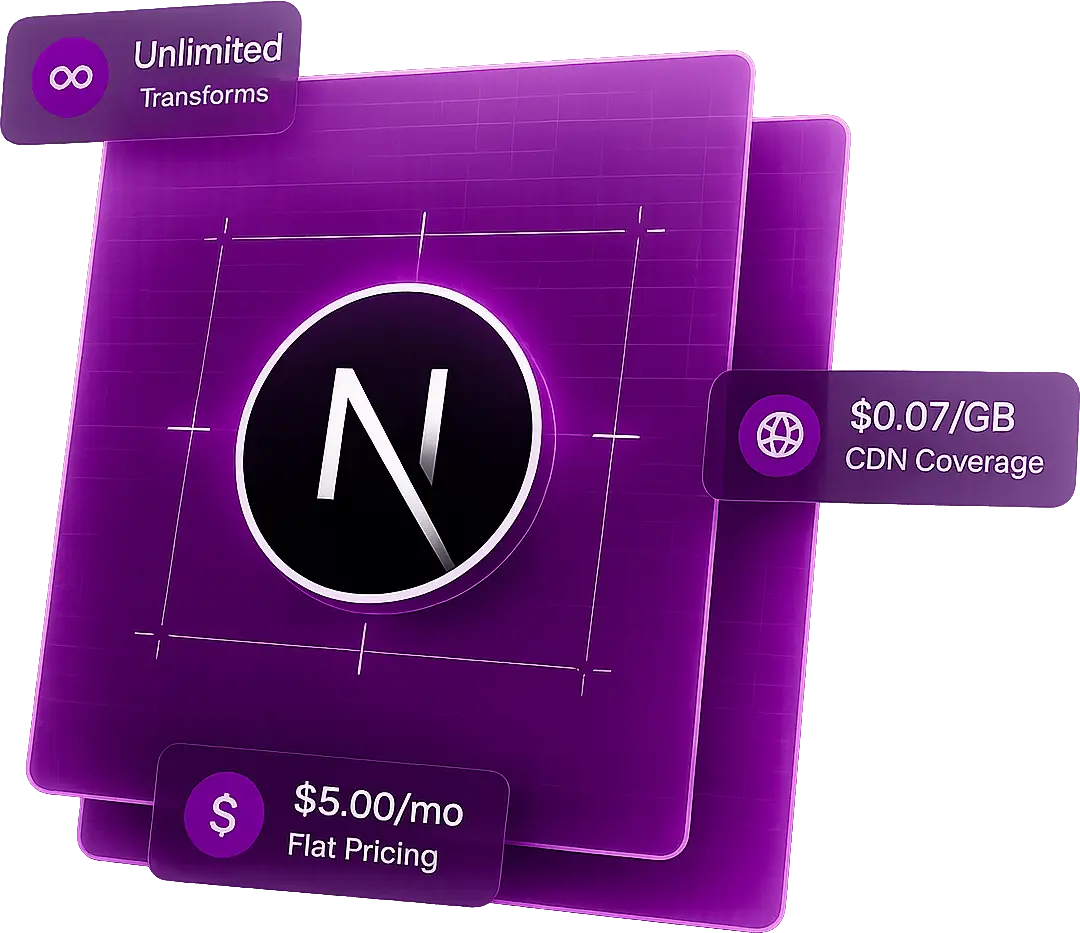
A flat monthly base price plus $0.07/GB CDN bandwidth overage after the included allowance. No per-transform fees, no cache-write charges, no edge-request meters.
Yes. Start on the default ImgNave URL and swap in your own hostname from the dashboard whenever you're ready. No code changes required.
Two lines of config. One deploy. Keep the wrapper, you're in. Remove it, you're back. Risk-free by design.
Dodo checkout · Reversible by design